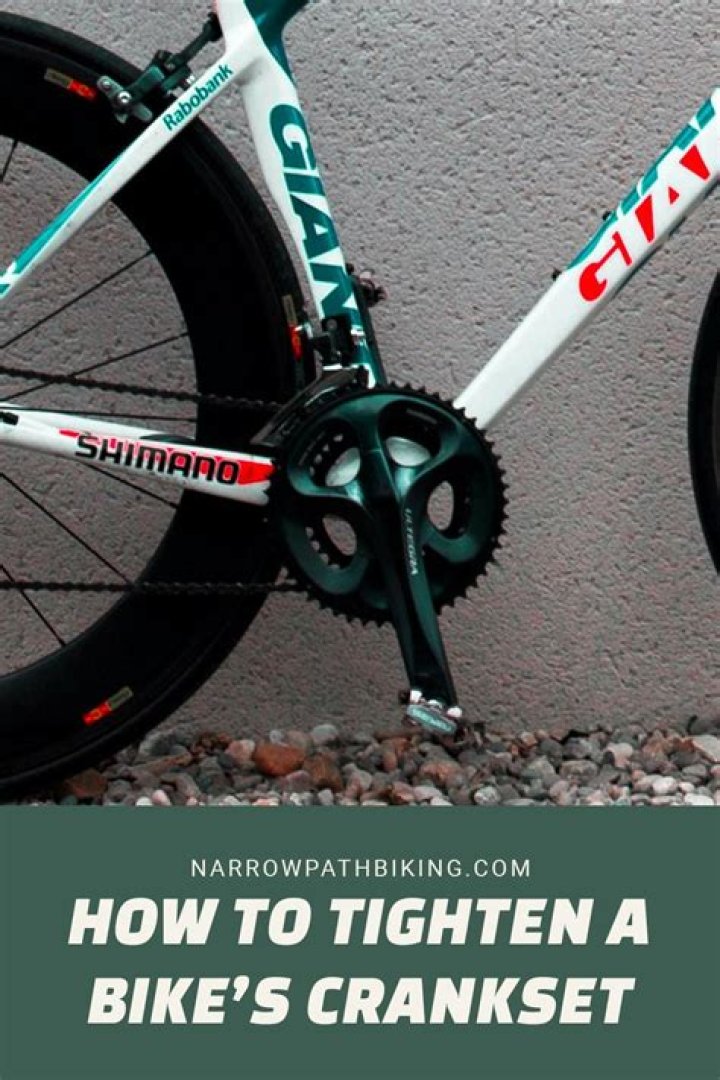
The tool is often called a crank thread chaser and is used to restore the required thread shape within the crank. It works by being made of strong high carbon steel which resembles the thread of a bike pedal, and when threaded through the crank, it carves/cleans out the thread and restores it to the correct shape.
What are the different types of crank?
Cranksets come in three main formats, single, double, and triple.
What is the thread on a bike pedal?
Bicycle pedals are commonly a 9/16″ x 20 threads per inch. The inside diameter of the internal thread (the “nut”) must be smaller. Measured in millimeters, the OD of the pedal is typically 14.2mm.
Are all bicycle pedals the same thread?
Are All Bike Pedal Threads the Same Size? No bike pedal threads are not the same size. These days there are two major sizes. For example, 9/16 20 TPI (threads per inch) is the most common size of thread used on bicycle pedals and will be the size needed for all modern bikes today.
What thread is a bicycle crank puller?
The 22mm thread fitting must be fully threaded into arm before pulling the arm. If spindle driver is not completely threaded and engaged into crank arm, the threads of the arm or nut may be damaged.
40 related questions foundCan you fix a stripped crank arm?
Thankfully if you have an aluminium crank, then cross-threaded cranks are easy to fix with a crank thread chaser. Another common way that crank threads are stripped is by not tightening the pedal enough when installing it.
How do you get a stuck crank arm off a bike?
I used a heat gun, until the crank arm was too hot to touch (was probably still well under the 100 degrees the outside of my kettle gets to) and then wound on the crank puller. It popped off quite easily.
Do all pedals fit all cranks?
To simply answer: No, bike pedals are not universal. Not only visually or for their different purposes for various cycling disciplines, but also internally. Bicycle pedals mainly have two sizes: 9/16” and ½”. The 9/16” is the more standard version of pedals and covers almost all subtypes.
Are my pedals 9/16 or 1 2?
If the cranks are THREE PIECES, meaning two crank arms bolted to a spindle, it will be 9/16 thread on the pedals. If the crank is ONE piece through a large bottom bracket housing, it's 1/2 thread.
How do I know what thread size my pedals are?
Check the Cranks on the Bike
Manufacturers made it easy to put the sizing on the crank, knowing that people would look for their pedal size. If your cranks are made up of three separate sections, two separate crank arms, and the spindle that goes through the frame, your pedals will be size 9/16″ x 20 TPI.
How do I know if a cranks will fit my bike?
Most manufacturers will print the type on the bottom bracket shell of your bicycle. Look for a match between the “shell width” of the bottom bracket and the “diameter” of the crankset's axle. If both are equal, use the crankset. On the other hand, you can use the BCD (Bolt Circle Diameter) to check compatibility.
Does crankset make a difference?
Absolutely! The main purpose of upgrading your crankset is for performance improvement and that means adjusting or replacing the crankset to get an improved experience. So yes, the crankset is always worth upgrading.
How do I know which crankset to buy?
Cranks come in a range of sizes, most commonly from 165mm to 190mm, and ideal crank length is often determined by three factors: your height, your cycling discipline and your personal preferences. If you change your crank length, it will change how it feels to pedal your bike, and it may change your fit on your bike.
What causes a thread to strip?
Stripped screws are caused by using the incorrect tools in the first place, and also by user error. Some things that will cause a screw to become stripped include: Using poor quality tools. Working too fast and without enough care.
Can you helicoil a bike crank arm?
A properly installed helicoil can be stronger than the original tapped aluminum. The trick is properly installing it, which takes fixturing the crank arm in a drill press or milling machine to drill the hole and guide the tap. If whoever does the work is knowledgeable and equipped to do this, it should be fine.
Which pedal is reverse threaded?
Remember, the left pedal spindle is reverse threaded. Turn it clockwise to remove the pedal when facing the crank arm. The right side is normal, so turn it anti-clockwise to loosen it.
What size is a bicycle crank puller?
Crank arms come in specific lengths. 170mm, 172.5mm, and 175mm are the most common.
Are all crank arm pullers the same?
There is no road versus mountain distinction with crank pullers. One size of extractor thread has been used on the vast majority of cranks for a long time, M22x1. There are several older sizes on cranks made by T/A, Stronglight, and possibly some more obscure ones, all of which need their own extractors.
How do you remove a Shimano crank arm?
Crank Removal
- Turn the left side crank cap counter-clockwise and remove. Shimano® cranks use a proprietary eight-pointed star driver. ...
- Pull left arm off spindle by hand. In some cases it may require light tapping with a soft mallet to remove arm if spindle-arm interface is dirty or sticky.
Why do pedals have different threads?
Right pedals are right-hand thread and left pedals are left-hand thread so that they self-tighten as you ride, preventing them from falling off — IF your bearings are working.
What are clipless pedals?
What are Clipless Pedals? Clipless pedals are actually a system comprised of special pedals and cleats, devices included with the pedals that attach to the soles of clipless cycling shoes. This means that you'll need to select pedals and shoes in order to upgrade to a clipless system.